

ABOUT THE EXHIBITION
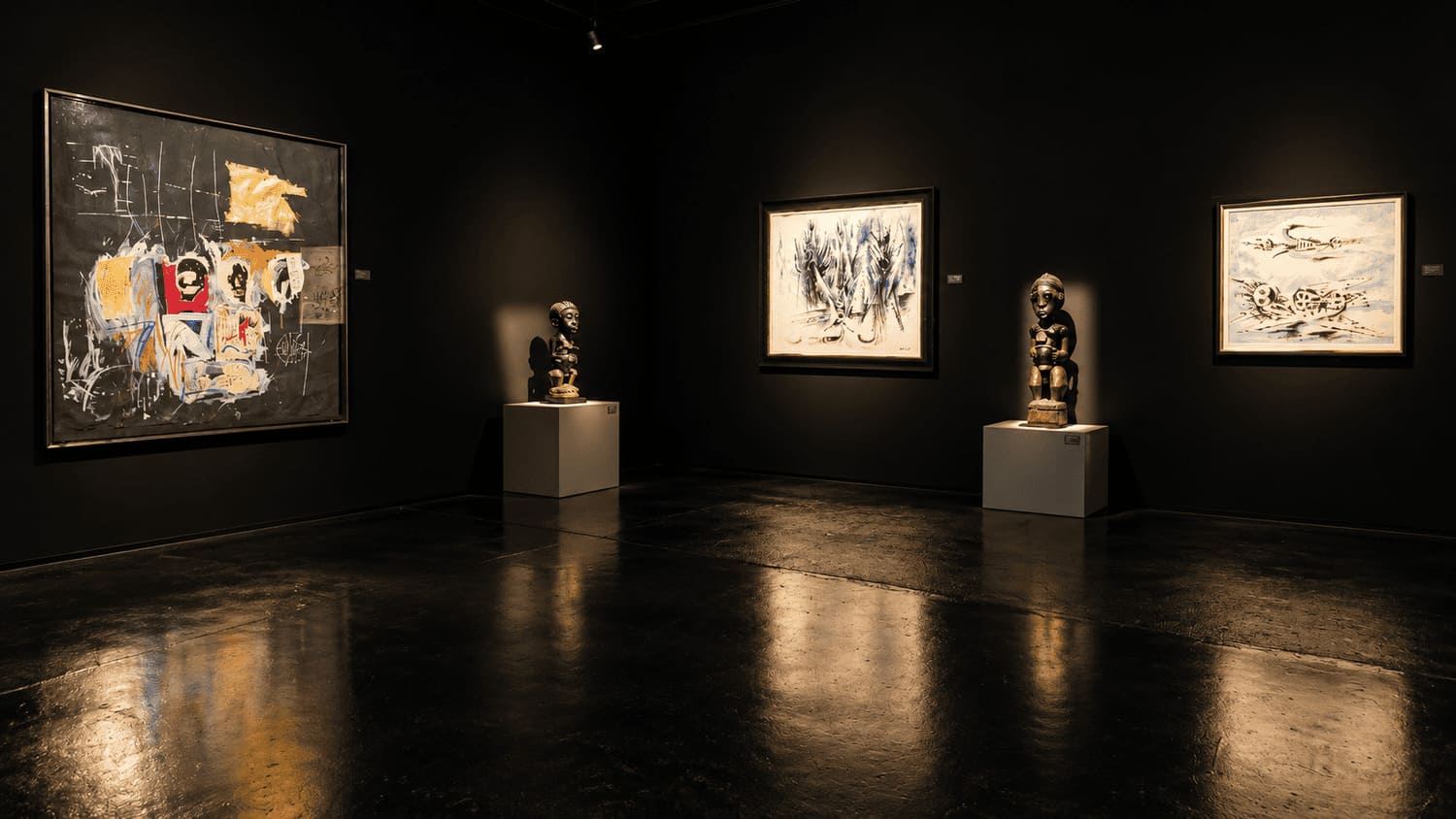
Gary Nader Art Centre presents LAM BASQUIAT SONGYE, an exhibition bringing together approximately thirty-five paintings and works on paper by Wifredo Lam (1902-1982) and Jean-Michel Basquiat (1960-1988) with a curated selection of Songye power figures and ritual objects from Central Africa. On view from December 1, 2026, through March 31, 2027, the exhibition considers how three distinct bodies of work use the human figure to address identity, memory, protection, spiritual force and transformation.
The Songye sculptures are central to the exhibition's curatorial framework. Created in the region now known as the Democratic Republic of the Congo, these works combine geometric structure, carefully worked surfaces and materials associated with ritual activation. Their presence invites viewers to encounter sculpture as more than representation: as an object shaped by social purpose, belief and the relationship between visible form and unseen forces.
Wifredo Lam developed a visual language in which human, animal and botanical forms merge into hybrid figures. Born in Cuba to a Chinese father and a mother of African, Spanish and Indigenous descent, Lam drew on the cultural and spiritual complexity of the Caribbean while engaging the artistic debates of Europe and the Americas. His elongated bodies, mask-like faces and shifting anatomies turn the figure into a space of ancestry, ritual and metamorphosis.
Basquiat approached the body through urgent drawing, fragmented anatomy, language, repetition and layered surfaces. Born in Brooklyn to a Haitian father and a Puerto Rican mother, he developed a practice shaped by the experience of the African diaspora and by histories that had been excluded, simplified or erased. In this context, his figures appear both vulnerable and charged, carrying references to power, race, history and self-definition.
Presented together, the paintings and sculptures reveal formal and conceptual correspondences without collapsing their different histories or cultural functions. Faces become diagrams of interior and collective experience; bodies hold memory; surfaces accumulate signs, materials and energy. The exhibition offers a focused encounter with three visual traditions and asks how art can make presence, power and transformation visible.
